Discuss Question
List three examples of plagiarism and discuss how plagiarizing as a student affects the integrity of a baccalaureate degree, the public perception of the nursing profession, and evidence-based practice. Describe two things you will do to ensure academic integrity in your work.
PLACE YOUR ORDER NOW
Please read below for more information.
Introduction
Academic nursing research is crucial to providing quality nursing care because it gives the foundation for evidence-based practice (EBP) that is often the catalyst for changes that impact patient outcomes. Learning to navigate databases to acquire sound evidence is the foundation for writing academic prose that illustrates the learner’s grasp of concepts. It is equally essential for RN-BSN students to learn to format academic writing properly, as well as understand how to avoid plagiarism and its repercussions. In addition, learning how to write without plagiarizing upholds the principle of trustworthiness that is a central element to the professionalism of nursing. Understanding academic research, literature review, scholarly writing, academic integrity, and academic dishonesty are the framework for a baccalaureate education, which also contribute to the professionalism of nursing. Additionally, learning to research relevant nursing topics forms critical-thinking skills necessary to provide excellent patient care.
Case StudyJulia, a 52-year-old nurse, returned to school for the first time in 30 years to get her bachelor’s degree at the prompting of her employer. Unfamiliar with writing papers, she had difficulty settling into the academic world. With the help of the university librarian and an online academic writing tutorial, she finished her first three online courses. Because she did not know how to find applicable articles or how to format her papers properly, she barely passed her first course. After completing the third course, the school contacted her to discuss one of her papers. After investigation, the university determined that Julia’s paper was largely plagiarized. An incident report was filed, placing Julia on academic probation. Devastated, Julia admitted that she was not certain what plagiarism truly was, but she certainly had no intention of doing anything dishonest. Julia said that many of her colleagues have spoken about getting papers and advice online and did not see the harm in it or consider it cheating. After thorough counsel from the faculty, Julia learned that the repercussions of such behavior go far past failing courses. She began to understand that plagiarism has a stark impact on the nursing profession and that dishonesty in academia can lead to dishonesty as a professional nurse. Such behavior jeopardizes patient care and can threaten the nursing license that she worked so hard to earn. Julia committed herself to learning how to avoid plagiarism and finding guidance on constructing strong academic papers for the rest of her baccalaureate education to help her uphold and model the principles key to the nursing profession.
Academic Writing

Academic writing is the analysis of material and the ability to express understanding in an eloquent and informative way while properly acknowledging sources (Hunker, Gazza, & Shellenbarger, 2014). Nonacademic writing does not use scholarly sources to substantiate claims made within the writing and is written at a more informal level that is easy for any reader to understand. Basics of academic writing, such as style, formatting, spelling, grammar, punctuation, and vocabulary, are often considered common knowledge. These concepts are also worth reviewing if they have faded from memory. In order to feel more prepared to tackle writing assignments with confidence, students often state the need for frequent review of such topics, particularly in the area of applying style and formatting according to the APA Style Manual (O’Brien, Marken, & Bennett Petrey, 2016). In fact, O’Brien, Marken, and Bennett Petrey (2016) discovered that the incorporation of mini studies on basics of writing throughout the length of a course led to improved writing and improved overall student perception related to writing assignments. This echoes the significance of exposure to the fundamentals of scholarly writing to set up students for success early in the academic process.
 A well-written, scholarly paper requires more than basic structure; it also needs an educated description of the topic that reflects the student’s critical thinking and comprehension (Borglin, 2012). Such comprehension is a stepping stone to formulating an evidence-based argument to support clinical reasoning in nursing practice and advocate for changes. Another key to this process is the students’ ability to evaluate relevant articles to support and substantiate the claims within their writing. Locating relevant articles is not sufficient; students must also be able to examine and fully understand the articles’ purpose and how it supports their writing (Hunker et. al., 2014). Blended together, these components contribute to the development of scholarly writing that is expected of students attaining a baccalaureate degree.
Tools for Success
The proper use of online databases is crucial to obtaining relevant data that can be used to support the students’ work. Grand Canyon University (GCU) has an online library system that allows for ease of access to such databases, including CINAHL and Ovid. The GCU Student Success Center contains a wealth of knowledge, providing detailed step-by-step processes instructing students on how to conduct effective database searches. Locating credible articles is crucial to substantiating claims made within pieces of academic writing. Information literacy can be defined as the learner’s ability to search for, access, and evaluate peer-reviewed articles (Brettle & Raynor, 2013). Peer-reviewed articles are research studies that have been evaluated by experts in the field prior to publication.
Becoming information literate is a crucial skill for students to master early on to lay a framework for success throughout the baccalaureate program. Throughout the program, students will be challenged to expand their knowledge and expertise by investigating new research and demonstrating their understanding of key concepts through scholarly academic writing and elaboration of ideas in discussion forums. When the basics, such as information literacy, are learned early, the process of academic writing becomes seamless and achievable. Not only is this helpful throughout the program, but it also contributes to the nurse’s ability to understand EBP and its impact on patient care. By learning how to evaluate articles for relevance and credibility, baccalaureate students will have the opportunity to understand EBP changes they see in their daily work during and after their baccalaureate experience.
Searching Databases
All nursing databases can be found in the “Find Journal Articles” and “Find Databases by Subject” section of the library under “Nursing & Health Sciences.” CINAHL Complete, PubMed, OVID Nursing Essentials, Cochrane Library, Nursing and Allied Health Collection, and ProQuest Nursing & Allied Health Source are recommended nursing databases; of these databases, CINAHL is the most widely recommended. The strategy when conducting research is to first identify the main concepts or keywords in the topic. Enter each concept in a separate search box. Then, add synonyms where possible to retrieve more search results. There are three Boolean operators that are used when searching in most library databases: AND, OR, and NOT. AND is used between each search box to connect different concepts. When using AND in a search, it will return results that use all keywords. OR is used to add synonyms, or similar keywords, to the search. Using OR in a search will return results that use at least one of the keywords provided. NOT is used to exclude keywords. Using NOT in a search will exclude the keyword provided from the results. When searching databases, using the truncation symbol (*), commonly referred to as an asterisk, can also be helpful in narrowing down search results. Truncation is used to include all possible endings on the end of the root word. For example, complian* will return results with the keywords compliance and compliant. Nurs* will return results that use the keywords nurse, nursing, nurses.
Scholarly writing requires students to support their research with current evidence published in reputable sources. When searching a database, students should click on the box limiting the search to only peer-reviewed journals. Students can limit search results to specific ranges of publication years as well. Typically, it is best practice to use articles that are no more than 5 years old; however students should check with their instructors to learn of any course specific requirements in terms of acceptable publication years.
Common Research Topic ExamplesTopic: Hand hygiene compliance to reduce the rate of infection1st Search Field: hand wash*2nd Search Field: AND compliant*3rd Search Field: AND infectionAnother way to search for this topic could include the following terms and operators:1st Search Field: hand hygiene2nd Search Field: AND adherence3rd Search Field: AND infectionTopic: Preventing diabetes through patient education1st Search Field: diabet*2nd Search Field: AND prevent* OR reduc*3rd Search Field: AND educat*Topic: Nurse shift reports to increase patient safety1st Search Field: nurs*2nd Search Field: AND shift report* OR handoff OR hand off OR bedside report*3rd Search Field: AND safe*
Review of the Abstract
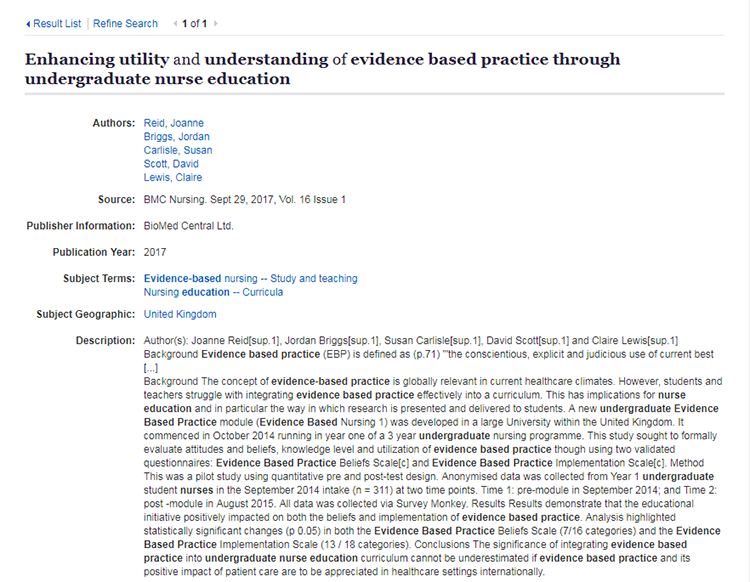
After searching, the student can begin looking through the results to select which articles are most relevant to their topic of interest. Reading the subject line of each article is not enough to understand whether the article has the type of material the student may need. This is when reviewing the abstract comes in handy. The abstract gives a brief overview regarding the article’s content and design. In this way, students can get a basic understanding of whether this article is a good fit to support their topic.
Figure 1.1
Abstract Example
Writing and Editing
Once the appropriate articles are found, they must be read and reviewed for topics and facts that can be used to support the paper’s main points. Finding just the right words to express ideas on a given topic can be difficult, particularly when unsure about how to best explain challenging concepts, properly cite sources, or correctly format the information according to APA style (O’Brien, Marken, & Bennett Petrey 2016). The greatest guidance possible for a student is to use every resource offered to help make the writing process easier. GCU’s Writing Center offers resources for students preparing to write an academic paper, including a step-by-step overview of writing academic papers, and example papers for reference. Learning to write scholarly papers enables students to demonstrate their understanding of concepts while growing in their ability to communicate effectively. Students concerned about the amount of writing required in a baccalaureate program can rest assured that most students acclimate to the challenge and are eventually able to write excellent academic prose.
Frequently reviewing and editing content helps students ensure that they are developing readable content that conveys the information as intended. Tools such as Microsoft Word’s grammar and spell check can help students to catch typos and grammatical errors; however, repeatedly reading and reviewing the content will ensure errors are located and fixed before submission. Reviewing the content also ensures that topics and paragraphs flow and transition from one to the next. Peer review is also an excellent way of fine-tuning completed work and eliciting ideas that can make for a more well-developed paper. The expertise of knowledgeable peers can give students a new perspective on the topic, broadening their understanding and helping to add depth to their prose (Doncliff, 2016).
Example of a Well Written ParagraphThe evidence regarding the effectiveness of clinical education models for undergraduate nursing programs is notably limited due to a lack of high quality studies and a lack of important student learning outcome measures. This systematic review found limited evidence that the clinical facilitator model is preferable to the preceptor model based on students’ preference and learning outcomes. It is evident that CEU model provided greater engagement and an enhanced learning environment compared with a standard facilitation model. However, this finding should be applied with caution due to the quality of the included studies. There is clearly a need for well-planned high quality studies to examine the effectiveness of different clinical placement models to provide best evidence-based practice in nursing education. (Jayasekara et al., 2018)
Formatting
Formatting documents according to the APA manual is crucial for students. APA is a writing style developed as a best practice for academic papers and is commonly required for use when writing papers in collegiate programs (Purdue Online Writing Lab, n.d.). Students should use the GCU library resources and GCU’s APA Style Guide, located on the Student Success Center. The APA manual includes information on how to format elements of a paper, such as headings, spacing, and indentations, as well as how to correctly reference, cite, and paraphrase sources of information. Omitting citations and poorly paraphrasing sources happens frequently and often leads to unintentional plagiarism. Plagiarism is a growing concern in education and has high incident rates in nursing education (Smedley, Crawford, & Cloete, 2015). Though colleges are using plagiarism prevention platforms, such as Turnitin, to check students’ work for plagiarized material, plagiarism remains a significant issue.
Academic Honesty
The issue of integrity is central to the world of nursing. Nurses are looked to as esteemed members of health care and society. Nurses are trusted to provide holistic and professional care to members of the community who are at their most vulnerable. In fact, according to an annual Gallup survey (2016) that looks at public trust in professionals, nurses have been ranked Number 1 as the most trusted profession for 15 years in a row (Norman, 2016). Integrity and honesty are crucial elements in upholding that reputation (Glasper, 2016). These defining characteristics are built during the education process. With that in mind, it becomes clear that academic integrity is the pathway to professional integrity as a nurse (Glasper, 2016).
 It is essential to understand and recognize academic dishonesty because academic behaviors lay the framework for upholding professionalism as a bedside nurse. Lack of integrity and dishonesty has been shown to lead to poor decision making at the bedside, which leads to poor patient outcomes and decreased patient satisfaction (Morgan & Hart, 2013). In fact, studies have found a direct correlation between not upholding academic integrity and dismissing professional policy in the workplace (LaDuke, 2013). This link cannot be overlooked, as it directly correlates to attributes required and expected of professional nurses. Additionally, it supports the thought that ethical behaviors are learned early on and affect behavior at the bedside, directly impacting patient care and outcomes (Coffey, Zitzelsberger, & Anyinam, 2014). For instance, if students see no fault in committing plagiarism throughout their educational journey, they may see no fault in falsely documenting assessment data or details of a patient interaction. The repercussions of omitting sensitive assessment data within the patient chart could lead to a complication going unnoticed that could ultimately lead to harmful complications for the patient.
Going back to the case study at the beginning of the chapter, it had been many years since Julia was in school. She was working full time as a bedside nurse and going to school, all of which added stress and pressure to her personal and professional life. This could also be a determining factor for why plagiarism occurred. Typically, in cases of plagiarism, the student is extraordinarily remorseful and fully committed to rectifying the situation. Despite these alarming statistics and inquiries, providing resources to students to help avoid this dilemma becomes the correct focus.
Patient with Acute Kidney Injury
At the end of the shift, a nurse was working to complete patient charts, including one patient’s hourly urine output. The nursing assistant emptied the patient’s Foley catheter but did not record the number or tell the nurse what she projected the urine output to be. The nurse is tired after a long shift, so she decides to make up a number so she can finish charting and get home. She lies and documents the total urine output for the shift as 500cc. The physician making rounds notes the output and sees no issue. When the nurse returned to work the following night, the patient is being placed on hemodialysis. The nurse from the previous shift told her the patient’s urine output was critically low, only 5–8cc per hour all day, and the patient’s blood urea nitrogen (BUN) and creatinine levels continued to rise despite best efforts to aggressively rehydrate him.
The situation could have had a much different outcome if the nurse had taken it upon herself to document the appropriate assessment findings accurately instead of lying. Though seemingly rare, such circumstances may occur more often than realized. These outcomes lead to a lack of trust from the public and diminished perception of the nurses’ professionalism.
Plagiarism
Plagiarism is the use of another’s words or ideas without clear identification of the source (Price, 2014). Plagiarism can occur intentionally and unintentionally. Intentional plagiarism involves a person who knowingly copied the work of another individual and purposefully omitted credit to the original author to take credit for the ideas. Unintentional plagiarism usually involves ignorance and poor writing, paraphrasing, and referencing skills (de Souza, 2016). In general, cheating is seen as common among college students, and many do not see it as wrong (LaDuke, 2013).
Studies have shown that plagiarism, particularly among nursing students, is a growing concern and has a host of repercussions that do not solely affect the education process. Nursing is a profession based on ethics, integrity, and trust; committing plagiarism is a direct insult to such an esteemed profession. Plagiarism can affect student performance and impact EBP created to affect change in patient care (LaDuke, 2013). Such behaviors are contrary to the Code of Ethics for Nurses, which summarizes the importance of maintaining and modeling exemplary behaviors such as honesty and integrity.
Table 1.1
Plagiarism Example
Source
Heinich, R., Molenda, M., Russell, J. D., & Smaldino, S. E. (1999). Instructional media and technologies for learning. Upper Saddle River, NJ: Prentice-Hall.
Original Source Material
Constructivism is a movement that extends beyond the beliefs of the cognitivist. It considers the engagement of student in meaningful experiences as the essence of learning. The shift is from passive transfer of information to active problem solving. Constructivists emphasize that learners create their own interpretations of the world of information.
Plagiarized Version
Constructivists do not hold views entirely opposed to those of the cognitivists. The position of constructivists extends beyond the beliefs of the cognitivist.
Reference
Heinich, R., Molenda, M., Russell, J. D., & Smaldino, S. E. (1999). Instructional media and technologies for learning. Upper Saddle River, NJ: Prentice-Hall.
Correct Version
Constructivists do not hold views entirely opposed to those of the cognitivists. The position of constructivists “extends beyond the beliefs of the cognitivist” (Heinich, Molenda, Russell, & Smaldino, 1999, p. 17).
Reference
Heinich, R., Molenda, M., Russell, J. D., & Smaldino, S. E. (1999). Instructional media and technologies for learning. Upper Saddle River, NJ: Prentice-Hall.
Note. Adapted from “How to Recognize Plagiarism” by Indiana University Bloomington, School of Education, 2014. Copyright 2014 by the Indiana University Bloomington, School of Education.
Why Do Nursing Students Plagiarize?
 Studies have found that plagiarism among nursing students is usually the result of their unfamiliarity with writing and the pressure they feel to get work completed while balancing a full plate of responsibilities (Morgan & Hart, 2013). Research has discovered that up to “94% of nursing students have seen another student cheat,” (LaDuke, 2013, p. 402). Other studies have indicated a connection to online programs and the lack of face-to-face interaction as a direct factor in upholding academic integrity (Morgan & Hart, 2013). Also, the amount of work expected within the nursing program is staggering; one study indicated that, “in nursing, there is a higher proportion of essay material required for students to produce than in other types of healthcare courses,” (de Souza, 2016, p. 19). Most RN-BSN students continue to work full time, attend classes, and balance a full family/home life, which can lead to an elevated level of anxiety that could then lead to unethical academic behavior (Hidle, 2014). These elements all contribute to the rise of unethical student behaviors in nursing education.
Paraphrasing
One of the most significant contributors to plagiarism is the ineffective use of references and paraphrasing (Hunker, et al., 2014). Merriam Webster defines paraphrasing as, “a restatement of a text, passage, or work giving the meaning in another form” (Paraphrase, n.d.). Paraphrasing is putting something found within a source into one’s own words versus directly quoting the work. While the use of paraphrasing may seem straightforward, it has become apparent that its misuse can be a big contributor to plagiarism (Rogerson & McCarthy, 2017).
Paraphrasing is a useful skill and can beautifully convey the writer’s understanding of a topic; however, changing a few words or using synonyms and expecting the result to be considered paraphrasing is insufficient. Proper paraphrasing involves synthesizing the given material and being able to reiterate in a way that exemplifies its meaning as well as giving credit to the original author with proper citation. Summarization is similar, requiring proper credit to the original work’s author but may reflect a more basic overview of the material (Eberle, 2013).
Table 1.2
Poor vs. Correct Paraphrasing
Original Quote
“New tracks aside, the challenge is at the bare minimum to bring light and air into this underground purgatory and, beyond that, to create for millions of people a new space worthy of New York, a civic hub in the spirit of the great demolished one, more attuned to the city’s aspirations and democratic ideals” (Kimmelman, 2012, para. 10).
Poor Paraphrase
Besides replacing the railroad tracks, the toughest part is to at least bring air and light to Penn Station. Millions of people in New York are deserving of a new civic hub, constructed in the same essence of the one that was leveled so many years ago. Moving forward with such a development ties in with the city’s enthusiasm for beauty and architecture
Effective Paraphrase
One of the biggest issues facing Penn Station’s revitalization is developing a brighter, airier space. It is an abysmal “underground purgatory,” (Kimmelman, 2012, para. 10) and with so many New Yorkers and tourists traveling in and out of its doors every day, it should be reconstructed to better reflect the endeavors and passions of the city.
Note. Adapted from “An Example of an Effective Paraphrase” and “An Example of a Poor Paraphrase” by EasyBib. Copyright EasyBib.
Students should also take caution when searching the Internet for tools or websites that may help develop paraphrasing material. The explosion of technological advancements and ease of access to these types of programs has made the opportunity for cheating or plagiarizing more appealing to students (Rogerson & McCarthy, 2017). Often these types of sources lead to plagiarizing and high similarity scores when papers are submitted to plagiarism prevention software such as Turnitin (Price, 2014). The best practice is for students to comprehend fully what scholarly writing involves and work to master the skill of writing scholarly papers, including accurately paraphrasing and avoiding plagiarism of material (Hunker et al., 2014). Avoiding plagiarism begins with understanding what it is, the consequences of the offense, and how it impacts the nursing profession.
Online Learning Platforms

As technology continues to advance and shape the future, it is evident that education will be affected along with it. Online learning has become commonplace, and its development continues to grow exponentially as the demand for flexible higher education choices continues to flourish. With that in mind, students must be mindful of the risks that online education delivers. Access to a large variety of sources through the Internet makes plagiarism and unethical academic practices easier than ever before. While acts of intentional plagiarism are less frequent, it is not uncommon for students to attain work from each other and even opt to purchase papers from sources providing such services. While the thought is reprehensible to some, the prospect of passing courses and getting through what may be considered an obligatory degree may prompt these behaviors. These acts are not only dishonest, but also a direct reflection of personal morality and the overall integrity of the nursing profession (Ganske, 2010).
Plagiarism Prevention Software
 As universities acclimate to the growing trends seen in education, there has been an influx of the use of plagiarism prevention software, such as Turnitin. These programs aim to reduce the incidences of plagiarism by comparing material submitted to existing works to catch gross negligence before students submit their assignments. While these types of programs are helpful to avoid large errors, they are not to be used in place of individual edits and review. These platforms are notorious for their inability to identify basic synonym replacements, as well as an inability to determine the use of an online paraphrasing tool within the work, both of which can constitute plagiarism (Rogerson & McCarthy, 2017). Students should understand that there are limitations to technology and review their work and have it peer reviewed for clarity and errors that can be edited before final submission.
Nurses are members of a profession in which being an expert is essential to providing thorough care (Glasper, 2016). Plagiarism and/or inappropriate use of paraphrasing may indicate a lack of understanding of the material, suggesting that the student may not fully grasp the concepts presented (Eberle, 2013). This, in turn, could lead to a population of nurses who may have achieved a baccalaureate degree without fully appreciating or applying the knowledge they worked so hard to attain. Also, the inability to thoroughly evaluate and understand presented concepts may lead to an inability to appreciate latest EBP and its implications for nursing practice.
EBP: Implications for Nursing Practice
EBP uses the latest evidence to drive change to patient care policies and procedures to optimize patient outcomes (Brower & Nemec, 2017). A proper understanding of EBP and its influence is critical for nurses to make decisions that fully impact patient care; therefore, it is evident that scholarly writing influences the nursing profession.
EBP is the driving force behind many practice revisions and updates in nursing (Stevens, 2013). From the time nursing students begin their education, the concept of EBP and its vital necessity in nursing practice is reiterated time and again. EBP drives nurses to increase their critical-thinking skills, observing and processing information as they practice and brainstorming ideas to make improvements. EBP takes nurses from being task-oriented to being educated problem solvers who use the scientific process to make relevant changes that impact their patients’ care and outcomes (Brower & Nemec, 2017). A report from the Institute of Medicine (IOM) (Olsen, Aisner, & McGinnis, 2009) stated that, “by 2020, 90 percent of clinical decisions will be supported by accurate, timely, and up-to-date clinical information and will reflect the best available evidence,” (p. 9). Following the IOM recommendations, most facilities base their patient care protocols on EBP to render optimal patient care outcomes. EBP is essential to nursing practice and is at the forefront of improving patient care.
Quality Improvements and Patient Outcomes
EBP is the foundation on which quality improvements are made, thus directly impacting patient outcomes. Experienced nurses can see these changes regularly occurring in their daily practice. EBP has the power not only to increase positive patient outcomes, but it also gives nurses a voice and the ability to help create sustainable changes in nursing. The ability to understand EBP’s importance and how its integration impacts nursing is an element of critical thinking that can be attained by learning to construct scholarly papers and being able to glean and apply knowledge presented throughout the baccalaureate program. The correlation and impact of these elements and what they mean for nursing cannot be overlooked. These skills are the foundation for fully appreciating knowledge gained in higher education (Stevens, 2013).
Application of Evidence in Nursing Practice
After evaluating evidence, it became apparent that making small changes for ventilated patients decreased their overall rates of acquiring pneumonia. A ventilator acquired pneumonia (VAP) prevention protocol was created and implemented that included small practice changes such as maintaining the patient’s head of the bed at 30 degrees at all times, administering a chlorhexidine mouthwash twice a day, and administering a peptic ulcer prophylactic medication daily. These implementations led to a remarkable decrease in the occurrence of VAP, thus markedly improving patients’ overall outcomes (DeJuilio, Rivera, & Huml, 2012).
Leadership
Leadership is a defining factor in nursing. Nurses assume the responsibilities of a leader in day-to-day practice regardless of formal role. Nurses lead by delegating tasks to other members of the health care team, as well as managing their patients overall care throughout a given shift. Effective leadership is rooted in ethical behavior; therefore, the element of academic integrity is a stepping stone to becoming an effective nurse leader. Hallmarks of nursing, including honesty, integrity, morality, and professionalism, are all traits of leaders as well. Nurses also have the continued opportunity for growth and career advancement into formal leadership roles such as nurse managers and supervisors. It is essential that nurses consider their ethical behavior and use it as a framework for their developing career as a nurse (Morgan & Hart, 2013). Doing so contributes to personal growth as well as the development of professionalism in nursing.
Reflective Summary
Scholarly writing is not just another hurdle to get through during the education process. Scholarly writing plays a significant role in the learning process and the overall comprehension of knowledge and has a direct effect on the nursing profession. The development of necessary skills, including formatting, are necessary to become a more proficient writer and effective communicator. Essential in this process is the understanding of plagiarism and cheating and its direct impact on the professional integrity of the nursing profession. Given the proper guidance and tools, students can overcome these academic challenges and become effective writers who succeed in advancing their professional goals.
Key Terms
Academic Dishonesty: The use of unauthorized assistance to complete assignments or deceive faculty and colleagues to pass a course or complete a program of study.
Academic Integrity: The upholding of moral and ethical values, such as honesty and integrity, when completing assigned academic work.
Citation: Method of attribution writers use to identify the source of information being used in their own work.
Database: A large collection of data organized especially for rapid search and retrieval.
Ethical: Concepts and beliefs regarding right, good, law-abiding, honest, and respectable behaviors; regarding moral values.
Evidence-Based Practice (EBP): The integration of clinical expertise, the most up-to-date research, and patient’s preferences to formulate and implement best practices for patient care.
Integrity: The quality of being honest and having strong moral principles; moral uprightness.
Literature Review: Evaluative report of scholarly articles that support the primary subject of the work being written.
Nursing Research: A detailed systematic study of a problem in the field of nursing. Nursing research is practice- or discipline-oriented and is essential for the continued development of the scientific base of professional nursing practice.
Online Learning: Formalized teaching method using technological platforms to deliver content to students.
Paraphrasing: To express content written by another writer using different words, especially to achieve greater clarity.
Peer-Reviewed Articles: Research studies that have been evaluated by experts in the field prior to publication.
Plagiarism: The practice of taking someone else’s work or ideas and passing them off as one’s own.
Professionalism: The competence, skills, and exhibited behavior of a set of trained workers (e.g., nurses, doctors, engineers).
References: Crediting scholarly sources within written work and within the reference section or bibliography of a scholarly paper.
Scholarly Writing: The process of writing based on careful thought, research, and applying learned concepts.
Summarize: To give a brief statement of the main points of something.
Technology: Methods, systems, and devices that are the result of scientific knowledge being used for practical purposes.
References
Purdue Online Writing Lab. (n.d.). APA Style Workshop. Retrieved from: https://owl.english.purdue.edu/owl/resource/664/1/
Borglin, G. (2012). Promoting critical thinking and academic writing skills in nurse education. Nurse Education Today, 32(5), 611-613. doi:10.1016/j.nedt.2011.06.009
Brettle, A., & Raynor, M. (2013). Developing information literacy skills in pre-registration nurses: An experimental study of teaching methods. Nurse Education Today, 33(2), 103-109. doi:10.1016/j.nedt.2011.12.003
Brower, E. J., & Nemec, R. (2017). Origins of evidence-based practice and what it means for nurses. International Journal of Childbirth Education, 32(2), 14-18.
Coffey, S., Zitzelsberger, H., & Anyinam, C. (2014). Academic integrity leads on to ethical practice. Nursing Standard, 29(4), 68.
de Souza, J. (2016). The plagiarism problem—reflections on plagiarism and nursing students. HLG Nursing Bulletin, 36(1), 18-23.
DeJuilio, P. A., Rivera, S. J., & Huml, J. P. (2012). A successful VAP prevention program. RT: The Journal for Respiratory Care Practitioners, 25(6), 26-29.
Doncliff, B. (2016). The peer-review process in scholarly writing. Whitireia Nursing & Health Journal, 23, 55-60.
Eberle, M. (2013). Paraphrasing, plagiarism, and misrepresentation in scientific writing. Transactions of the Kansas Academy of Science 116(3-4), 157-167. doi:10.1660/062.116.0310
Ganske, K.M. (2010) Moral distress in academia. OJIN: The Online Journal of Issues in Nursing, 15(3). doi: 10.3912/OJIN.Vol15No03Man06
Glasper, A. (2016). Does cheating by students undermine the integrity of the nursing profession? British Journal of Nursing, 25(16), 932-933.
Hidle, U. (2014). The lived experience of associate degree nursing students intending to pursue the RN-BSN. International Journal of Nursing Education, 6(1), 249-253. doi:10.5958/j.0974-9357.6.1.051
Hunker, D. F., Gazza, E. A., & Shellenbarger, T. (2014). Evidence-based knowledge, skills, and attitudes for scholarly writing development across all levels of nursing education. Journal of Professional Nursing, 30(4), 341-346. doi:10.1016/j.profnurs.2013.11.003
Jayasekara, R., Smith, C., Hall, C., Rankin, E., Smith, M., Visvanathan, V., & Friebe, T. (2018). Review: The effectiveness of clinical education models for undergraduate nursing programs: A systematic review. Nurse Education in Practice, 29, 116-126. doi:10.1016/j.nepr.2017.12.006
Kimmelman, M. (2012). Restore a gateway to dignity. The New York Times. Retrieved from http://www.nytimes.com/2012/02/12/arts/design/a-proposal-for-penn-station-and-madison-square-garden.html.
LaDuke, R. D. (2013). Academic dishonesty today, unethical practices tomorrow? Journal of Professional Nursing, 29(6), 402-406. doi:10.1016/j.profnurs.2012.10.009
Morgan, L. & Hart, L. (2013). Promoting academic integrity in an online RN-BSN program. Nursing Education Perspectives, 34(4), 240-243. doi: 10.5480/1536-5026-34.4.240
Norman, J. (2016). Americans rate healthcare providers high on honesty, ethics. Retrieved from: http://news.gallup.com/poll/200057/americans-rate-healthcare-providers-high-honesty-ethics.aspx
O’Brien, S. P., Marken, D., & Bennett Petrey, K. (2016). Student perceptions of scholarly writing. The Open Journal of Occupational Therapy, 4(3). doi: http://dx.doi.org/10.15453/2168-6408.1253
Olsen, L., Aisner, D., & McGinnis, M. (Eds.). (2009). The learning healthcare system: Institute of Medicine roundtable on evidence-based medicine—Workshop summary. Washington DC: National Academies Press.
Paraphrase. (n.d.). In Merriam-Webster’s online dictionary (11th ed.). Retrieved from https://www.merriam-webster.com/dictionary/paraphrase
Price, B. (2014). Avoiding plagiarism: guidance for nursing students. Nursing Standard, 28(26), 45-51.
Rogerson, A., & McCarthy, G. (2017). Using Internet based paraphrasing tools: Original work, patch writing or facilitated plagiarism? International Journal for Educational Integrity, 13(1), 1-15. doi:10.1007/s40979-016-0013-y
Smedley, A., Crawford, T., & Cloete, L. (2015). An intervention aimed at reducing plagiarism in undergraduate nursing students. Nurse Education in Practice, 15(3), 168-173.
Stevens, K. R. (2013). The impact of evidence-based practice in nursing and the next big ideas. OJIN: Online Journal of Issues in Nursing, 18(2). doi:10.3912/OJIN.Vol18No02Man04
PLACE YOUR ORDER NOW